
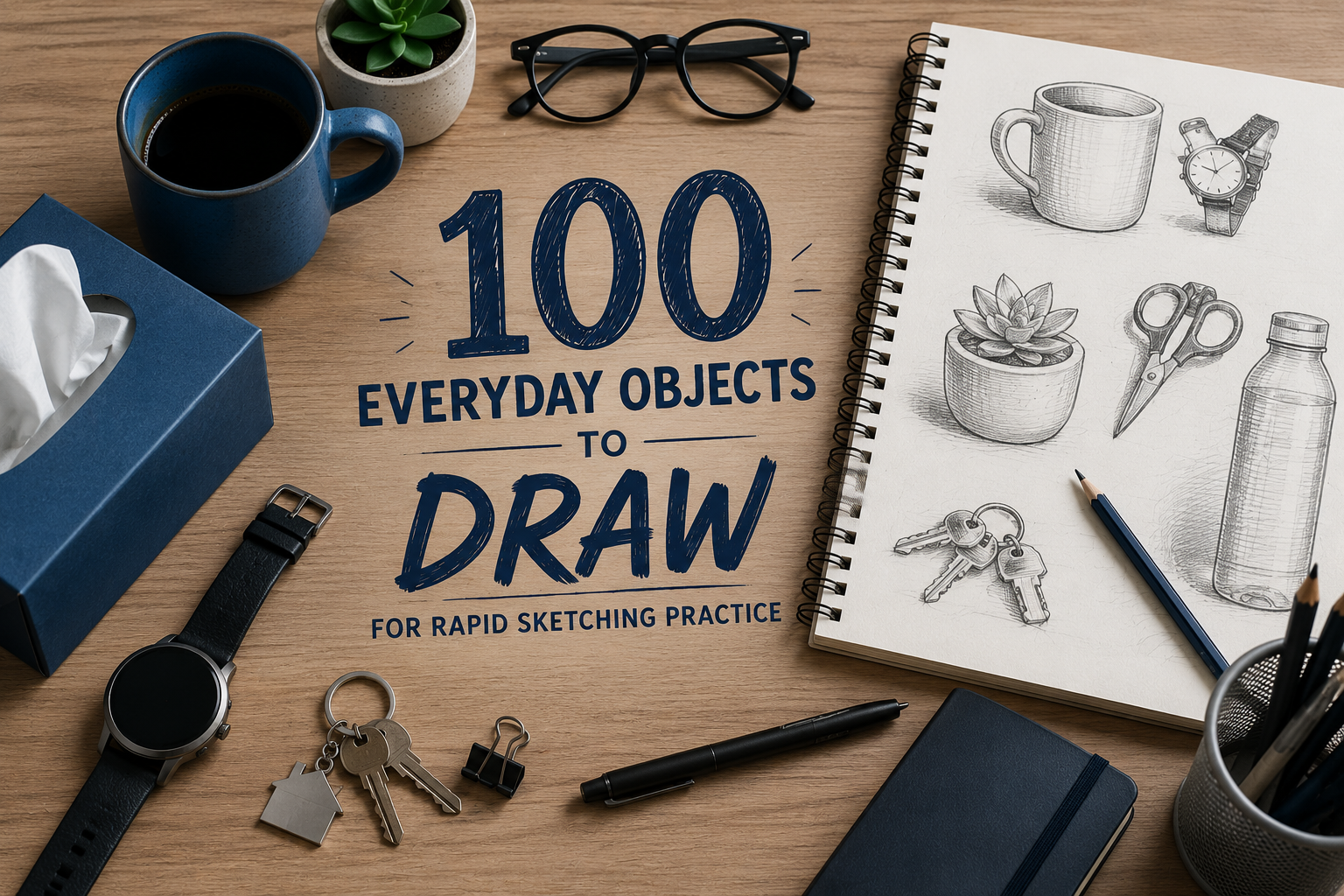
Everyday Objects to Draw for Rapid Sketching Practice
Drawing the everyday objects around you is one of the fastest ways to improve your sketching. A mug, a shoe, or a houseplant sitting right in front of you gives your brain real shapes, real light, and real proportions to work with, instead of the fuzzy memory of what you think those things look like.
That is why observational drawing is such an effective exercise. Working from real items in real 3D space builds muscle memory, spatial awareness, and line confidence quickly. It also removes the frustration of drawing from imagination, because you always have a tangible subject ready when you sit down to practice.
Simple Geometric Form Objects (Beginner Warm-Ups)
Starting with objects that mimic basic primitives like spheres, cylinders, and cubes helps build your muscle memory. Focus on clean contour lines and simple core shadows.
- Ceramic Coffee Mug: Practice drawing ellipses for the top opening and matching the curvature at the base.
- Tissue Box: Ideal for testing your two-point perspective and parallel lines.
- AA Battery: A classic exercise for tight, symmetrical cylinder construction.
- Sticky Note Pad: Great for foreshortening and sharp corner angles.
- Apple or Orange: Focus on subtle surface contour lines and soft shadow gradients.
- Soda Can: Wrap text naturally around a curved surface.
- Hardcover Book: Practice drawing planes at different angles in space.
- Cardboard Box: Perfect your vertical line alignment.
- Wooden Ruler: Work on clean parallel lines and flat surface details.
- Square Coaster: Simple exercise for flat plane distortion.
- Candle Jar: Focus on cylindrical transparency and wax textures.
- Soap Bar: Great for rounded organic corners.
- Tennis Ball: Practice continuous curved seam lines on a sphere.
- Cereal Box: A tall rectangular prism to test edge vanishing points.
- Cylindrical Marker: Fast warm-up for small concentric ellipses.
Household & Kitchen Items (Intermediate Texture Work)
Once basic primitives feel comfortable, move on to household items that feature mixed materials, reflective metals, and overlapping parts.
- Kitchen Scissors: Pay close attention to negative space inside the handle loops.
- Stainless Steel Fork: Focus on parallel tine spacing and metallic reflections.
- Chef’s Knife: Excellent for practicing sharp metallic edge shading.
- Wine Glass: Practice thin glass transparency, liquid refraction, and delicate stems.
- Potted Succulent: Challenge your ability to draw repeating, overlapping leaf shapes.
- Set of House Keys: Focus on metallic textures and sharp teeth edges.
- Whisk: A fantastic challenge for overlapping wire lines and spatial depth.
- Coffee Maker: Work on combining plastic, glass, and metal textures.
- Electric Toothbrush: Practice subtle ergonomic curves.
- Spatula: Simple flat plane with a long cylindrical handle.
- Avocado Half: Practice pit vs. pebbled skin texture.
- Ceramic Bowl: Test symmetrical curvature.
- Toothpaste Tube: Challenging crumpled metal foil texture.
- Spray Bottle: A dynamic shape with a mechanical trigger.
Personal Accessories & Clothing (Complex Forms)
Fabric folds and flexible accessories require you to abandon rigid perspective rules and observe organic, fluid form changes.
- Worn Leather Shoe: Focus on leather creases, stitching details, and sole thickness.
- Winter Glove: Practice soft fabric folds and finger proportions.
- Wristwatch: A detailed exercise for dial numbers, hands, and leather band texture.
- Eyeglasses/Sunglasses: Test your symmetry and transparent lens refractions.
- Baseball Cap: Practice cloth panel seams, visor curves, and fabric folds.
- Backpack: Challenge yourself with zippers, fabric tension lines, and practical straps.
- Headphones: Excellent for cushioned ear pads and curved headband arches.
- Leather Wallet: Work on stitch lines and worn edge textures.
- Umbrella (Closed): Long converging folds.
- Denim Jacket (Draped): Practice heavy fabric weight and converging deep folds.
- Ring: Small details, high specular highlights.
- Flip-Flops: Sole thickness exercise.
- Beanie: Repeating soft knit textures.
- Belt with Buckle: Practice leather thickness and metallic highlight.
- Keychain: Test small, varied material grouping.
Office Tools & Workspace Items (Precision Drawing)
Desktop tools are packed with mechanical details that punish lazy proportion checking. Use these to train your eye for accuracy.
- Computer Mouse: Practice subtle ergonomic curves and smooth plastic reflections.
- Mechanical Pencil: Focus on tight mechanical joints and grip knurling.
- Desk Lamp: A classic study for jointed metal arms and shades.
- Open Notebook: Practice curved page lines and spiral binding loops.
- Stapler: Work on metallic joint mechanics.
- USB Flash Drive: simple minimalistic box drawing with small bevel details.
- Paperclip: Easy warm-up for continuous bent wire loops.
- Keyboard: A rigorous test for repeating grid alignment.
- Tape Dispenser: Concentric circles and sharp teeth.
- Desk Chair: Complex challenge for wheel bases and mesh textures.
- Calculator: Button grid alignment exercise.
- Monitor: Large flat plane distortion.
- Highlighter Pen: Fast cylinder exercise with chisel tip.
- Headphone Stand: A sleek metal curve exercise.
- External Hard Drive: Clean minimalistic box drawing with port details.
Nature Objects & Everyday Groceries (Organic Forms)
Nature creates irregular, organic shapes that encourage a looser, gesture-based drawing approach. Don’t overthink these.
- Pinecone: A masterclass challenge in repeating radial scale patterns.
- Tree Leaf: Focus on central vein structures and irregular edge serrations.
- Feather: Delicate central quill lines and soft barb textures.
- Acorn: Textural contrast between cap and nut.
- Smooth River Rock: subtle plane changes and soft shading.
- Flower Bud: Overlapping petal layers wrapping around a core.
- Dandelion Head: light radial seed structures.
- Slice of Bread: Practice organic internal textures.
- Banana Peel: complex unfolding organic planes.
- Egg: The simplest exercise in subtle form shading.
- Rose Bud: repeating overlapping organic layers wrap.
- Dandelion: delicate seed structure radial symmetry.
- Mushroom: organic curves and subtle shading.
- Shell: spiral growth patterns natural curvature.
- Walnut: complex irregular hard surface texture.
Spontaneous Everyday Clutter (Quick Studies)
keep practice fresh by grabbing random clutter without overthinking. removes breakdown.
- House Key Lock: intricate internal mechanics keyhole details.
- Lip Balm Tube: quick cylinder warm-up concentric ellipses.
- Candle Tin: simple metal shape wax surface texture.
- Toothpaste Tube (Crumpled): advanced texture rendering compression folds.
- Hand Sanitizer Bottle: clear liquid level transparency details.
- Padlock: combining diverse geometric forms in depth.
- Sunglasses Case: complex ergonomic curves clamshell mechanism.
- Coin Stack: repeating disk patterns perspective distortion.
- Lightbulb: glass curvature filament wire details.
- Guitar Pick: flat triangular shape with soft bevels.
- Safety Pin: single continuous wire form exercise.
- Toilet Paper Roll: simple hollow cylinder warm-up.
- Pill Bottle: ridged cap details transparent body.
- Compass: detailed circular dials internal needle mechanisms.
- Eraser: simple block structure soft edge compression.
How to Maximize Your Observational Drawing Practice
Draw from life whenever you can. A real object sitting in front of you gives you instant feedback: you can see right away when a line is off, and fixing it trains your eye. Real subjects beat photos and memory every time, because you can move around them, watch how light wraps across their surfaces, and check proportions from different angles.
Set a timer and keep your sessions short. Fifteen minutes per study is plenty. A time limit keeps you focused on big shapes and correct proportions instead of polishing tiny details too early. Short daily warm-ups build skill and confidence far faster than one long session each month.
Use one strong light source. A single lamp placed near your subject creates clear highlights and cast shadows, which makes it much easier to read the three-dimensional form of an object. When you can see exactly where light turns into shadow, shading becomes a simple decision instead of a guess.
If decision fatigue slows you down, let our automated Random Object Generator pick a subject for you, or switch to our specialized Random Drawing Generator for warm-ups grouped by category. Removing the decision step means you start sketching sooner, and consistent daily practice is what builds real skill.
Frequently Asked Questions
Is this free random object generator really free?
Yes, this random object generator is 100% free to use with zero hidden fees, microtransactions, or usage caps. You can generate unlimited lists of unique daily drawing prompts or classroom object suggestions without creating an account or providing personal details.
Why should artists draw everyday objects instead of fantasy subjects?
Everyday objects exist directly in front of you in real 3D space. Drawing them forces you to observe real lighting, spatial relationships, and proportions accurately, which builds a strong visual memory library far superior to photo references or memory.
How many objects should I draw per day for visible progress?
Visible progress comes from consistency, not volume. Focusing on one to three focused observational studies per daily session is ideal for rapid growth. Spending 15 to 30 minutes on focused practice builds strong muscle memory without causing mental fatigue or artistic burnout.
Can I use random objects to practice drawing from imagination?
Yes. Generate an object, study it for a minute, then put it away and draw it from memory. Compare your sketch with the real thing to spot what your brain got wrong. This exercise strengthens visual memory and trains you to notice the details you usually skip. Over time, your imagined drawings will look far more believable.
Is there a way to filter the database for specific categories like geometry or nature?
Currently, our primary tool generates objects from a unified random database. However, you can use automated filters on our specialized Random Drawing Generator sub-tool to instantly generate prompts specifically designed for geometry warm-ups, organic nature forms, or hard-surface practice.






4 Comments