
10 Classroom Warm-Up Games That Take 5-10 Minutes (Zero Prep)
The first five minutes of class decide the next fifty. A good warm-up gets every brain in the room switched on before the real lesson starts, and the best ones need zero preparation. Here are 10 classroom warm-up games that take five to ten minutes each, work for almost any grade, and need nothing you do not already have.
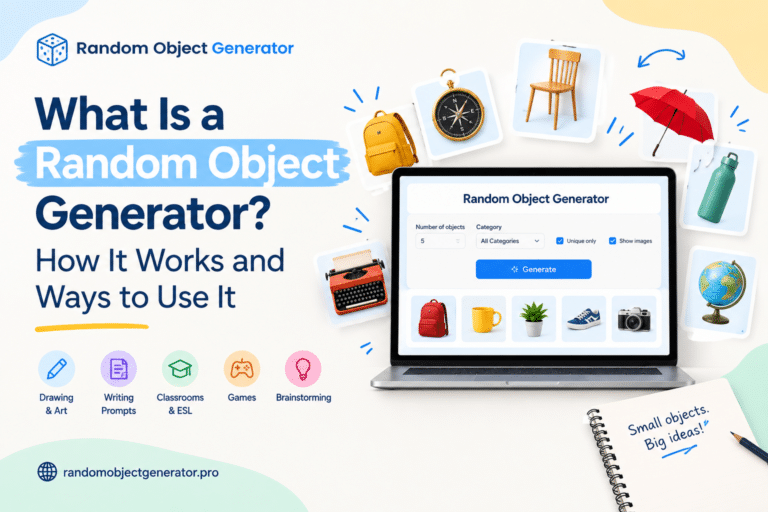
Every game below runs on one simple engine: a random object. You can pull them from a hat, from a word list, or from our free random object generator with pictures. The randomness is the point. When nobody knows what is coming next, everybody pays attention.
In this post:
- 10 zero-prep warm-up games (with time, grades, and steps for each)
- How to run any warm-up without losing control of the room
- Why a few minutes of play makes the rest of the lesson easier
Need a Warm-Up in the Next 60 Seconds?
Class starts in one minute and you have nothing planned. Here is your rescue plan:
- Project one random object picture for the class to see.
- Set a visible 5-minute timer.
- Say: “Sketch it, describe it, or invent a story about it. Go.”
That is the whole warm-up: no printing, no prep, no materials beyond what is already in the room. Want a bigger idea bank for drawing days? This list of things to draw when bored has 100 prompts sorted for beginners.
Need a Warm-Up in the Next 60 Seconds?
Project one random object picture. Set a 5-minute timer. Go.
Game 1: Mystery Object Sketch
Time: 5 minutes | Grades: 3-12 | You need: a projector or whiteboard
Project one random object picture where everyone can see it. Students sketch it from observation in their notebooks. No erasing, no talking, just looking and drawing. When the timer ends, everyone holds up their sketch for a 30-second gallery walk.
Why it works: Observation drawing forces genuine focus. A student cannot fake their way through drawing a stapler. They have to actually look at it, and that looking switches the brain from hallway mode to classroom mode.
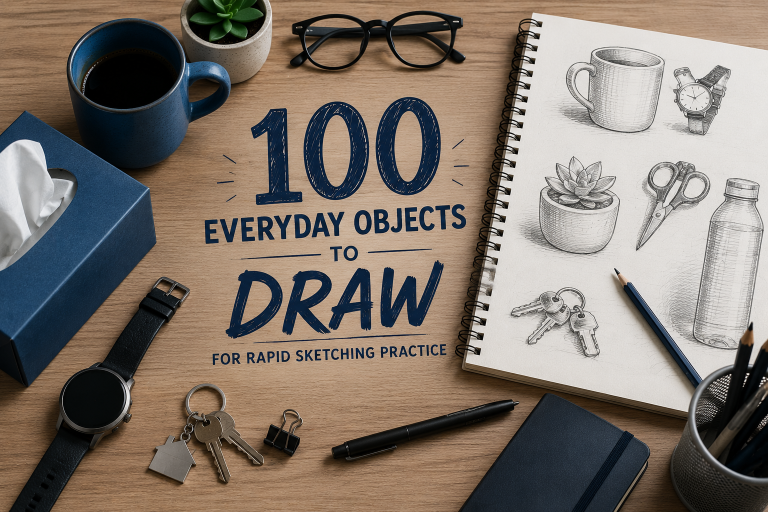
Teacher tip: Use the picture mode of a random object generator with pictures so the image is always classroom-safe and you never have to vet it. If you want a bigger bank of sketchable objects, our everyday objects drawing list has 100 sorted by difficulty.
Game 2: Describe and Draw
Time: 8-10 minutes | Grades: 2-12 | You need: nothing (pairs)
Pair students up. One partner sees a random object picture (on your screen or a printed card). They describe it without naming it while their partner draws blind, following only the description. Then they compare the drawing to the real thing and switch roles.
Why it works: This is secretly a listening and speaking exercise wearing a game costume. The describer practices precise language (“it has a curved handle on the left side”), and the drawer practices following instructions. ESL teachers love this one because it builds vocabulary and circumlocution at the same time.
Game 3: 60-Second Speed Sketch
Time: 5 minutes | Grades: K-12 | You need: a timer
Call out random objects one after another. Students get 60 seconds per object, then must move on whether they finished or not. Five objects, five minutes, five gloriously unfinished sketches.
Why it works: The time pressure kills perfectionism. Students who normally freeze because their drawing “is not good enough” discover that nobody can judge a 60-second sketch, so they just draw. I have watched reluctant drawers become the most enthusiastic players of this game.
Game 4: Story Chain
Time: 8 minutes | Grades: 3-12 | You need: one random object
Show the class one random object. The first student says one sentence of a story about it. Each following student adds exactly one sentence. The story must keep going until everyone has contributed or the timer ends.
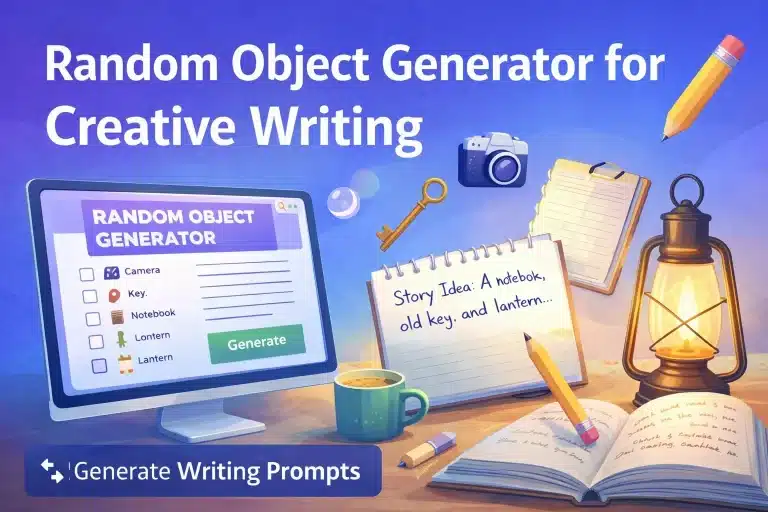
Why it works: One sentence is a low bar, so even quiet students participate. But the constraint forces creativity: student number twelve has to build on eleven sentences they did not write. It is collaborative writing practice disguised as a party game. For more story-starting fuel, browse our object writing prompts for ideas you can pair with this game.
Game 5: Pictionary Lightning
Time: 10 minutes | Grades: 2-12 | You need: whiteboard, teams
Split the class into two teams. Generate random objects with “unique only” mode so nothing repeats. One player draws, their team guesses, 60 seconds per round. Alternate teams until the timer ends.
Why it works: Team energy transforms a quiet room. The drawing player practices visual communication under pressure, and the guessing team practices rapid association. Use a free random object generator for the word list so nobody can accuse you of picking easy words for one team.
Game 6: Vocabulary Vault (ESL Favorite)
Time: 10 minutes | Grades: 2-12, adult ESL | You need: projector
Display one random object picture. Students must: (1) name it, (2) spell it aloud, (3) use it in a full sentence, (4) describe it without naming it while a partner guesses. Four skills, one picture, ten minutes.
Why it works: Vocabulary sticks when it is used four ways instead of one. The randomness keeps it fresh across weeks because the words never repeat in a predictable pattern.
Game 7: Mash-Up Inventions
Time: 10 minutes | Grades: 4-12 | You need: nothing
Generate two completely unrelated random objects. Each student (or pair) invents a product that combines both, then pitches it to the class in 30 seconds. Lantern plus bicycle wheel becomes a night-market bike light. Teapot plus skateboard becomes a mobile tea cart.
Why it works: Forced association is one of the most reliable creativity techniques there is. When the brain meets two unrelated things, it cannot help building a bridge between them, and that bridge is always original because the starting points were random. This one doubles as a brilliant brainstorming warm-up for older students.
Game 8: Odd One Out
Time: 5 minutes | Grades: 3-12 | You need: four random objects
Show four random objects. Students must pick which one does not belong AND defend their choice out loud. The catch: there is no single right answer. A pillow, a hammer, a cloud, and a brick: the cloud is the only non-solid, but the hammer is the only tool.
Why it works: Defending a choice out loud is critical thinking practice. Students learn that reasoning matters more than the answer, which is a lesson that transfers to every subject. The debate usually gets lively, which is exactly the energy you want at the start of class.
Game 9: Memory Tray
Time: 5 minutes | Grades: K-12 | You need: projector
Display five random object pictures for exactly 30 seconds, then hide them. Students write down as many as they can remember, in any order. Reveal and score: one point per correct object, bonus point for correct order.
Why it works: Thirty seconds of deliberate attention is a workout for working memory. Students develop their own strategies (grouping, storytelling, visualization) without being taught any.
Game 10: Exit Ticket Doodle
Time: 3 minutes | Grades: 3-12 | You need: nothing (end of class)
This one closes the lesson instead of opening it. Each student draws one object that represents what they learned today, then writes one sentence explaining the connection. Photosynthesis becomes a solar panel. Fractions become a pizza.
Why it works: Translating an abstract lesson into a concrete object forces real comprehension. A student who can connect today’s concept to a drawing understood it; a student who cannot has just shown you exactly what to reteach tomorrow. Three minutes of drawing buys you a whole class of formative assessment.
How to Run Any Warm-Up Without Losing Control
Warm-ups fail for management reasons, not content reasons. Four rules keep all ten games tight:
- The timer is visible and non-negotiable. When it rings, the game ends, even mid-sentence. Students respect a boundary that never moves.
- One start signal, one stop signal. Clap pattern, hand raise, countdown. Same signals every day until they are automatic.
- Participation beats perfection. Say it out loud on day one: there are no wrong answers in warm-ups, only warm brains. Mean it.
- Rotate who picks. Let a different student generate the random object each day. Ownership kills the “this is boring” reflex before it starts.
A warm-up is not filler. It is the on-ramp that gets brains up to speed, and a few deliberate minutes at the start saves fifteen distracted minutes later.
Why a Few Minutes of Play Makes Teaching Easier
Here is the honest reasoning. A class that has just laughed together, competed lightly, or solved something small walks into the lesson already alert. Attention is a resource that depletes, and the first deposit of the period matters more than any other.
Zero-prep does not mean zero-thought. The best warm-ups are simple to run and rich to think about, and every game above earns its place by making the next forty-five minutes easier.
Ready for Tomorrow’s First Few Minutes?
One click, one random object, a few focused minutes. Your future self says thank you.
What is a good 5-minute warm-up activity for class?
Project one random object picture and have students sketch it, describe it, or invent a story about it in five minutes. It needs zero preparation, works for any grade, and switches students from hallway mode to learning mode. A visible timer keeps it tight and signals that the lesson has officially started.
How do warm-up activities help students learn?
Warm-ups capture attention before the main lesson begins, which matters because focus is hardest to win in the first minutes of class. Short, low-stakes activities also activate prior knowledge and build participation habits. Students who have already spoken, drawn, or laughed once participate more easily for the rest of the period.
What are some no-prep warm-up games for elementary students?
Speed sketching (60 seconds per object), memory tray (recall five pictures after 30 seconds), and describe-and-draw in pairs all need zero materials and work from kindergarten up. The key for young students is a visible timer and a clear start signal. Keep instructions to one sentence and demonstrate the first round yourself.
Do warm-up games work for online or ESL classes?
Yes, and some work even better online. Screen-share a random object picture and run describe-and-draw in breakout rooms, or use vocabulary vault (name it, spell it, use it in a sentence) as a daily ESL ritual. The games that rely on talking and listening transfer perfectly to video calls because they never needed physical materials.
Where can I find free warm-up ideas for every day?
Use a free random object generator with pictures to get a fresh prompt each morning with one click. One random object becomes a sketch prompt, a vocabulary word, a story starter, or a debate topic depending on which game you pick. Bookmark this page for the ten games, and let the generator supply the raw material.