25 Icebreaker Games for Kids (Classroom, Camp, and Parties)
Icebreaker games for kids are short, low-prep group activities that help children learn names, feel included, and get comfortable with strangers fast. The best ones need little or no equipment, run five to fifteen minutes, and mix talking with movement. This post gives you 25 kid-friendly icebreakers, sorted by setting: classroom, camp and outdoor, and party.

What Are Icebreaker Games for Kids?
An icebreaker is a short activity that warms up a new group so kids start talking, laughing, and cooperating instead of standing around quietly. Games work better than introductions because nobody has to speak in front of everyone until they are ready. The activity does the talking for them.
Icebreakers matter most in the first ten minutes. A group that has already laughed together learns faster, listens better, and includes the shy kids without being asked. I have seen a quiet child who would not say her name out loud shout answers in a ball-toss game five minutes later. The right game changes the room.
The quotable truth: A good icebreaker does not fill time. It gives every child a reason to talk to someone new.
Which Icebreaker Games Work Best in a Classroom?
Classroom icebreakers need to fit desks, short time slots, and a teacher who cannot spend ten minutes on setup. These eight run on names, voices, and paper, and each one doubles as a warm-up for learning.
1. Name Ball Toss
Kids stand in a circle and toss a soft ball. The thrower says the receiver’s name first, then tosses. If the name is wrong, the group helps. After two rounds, add a second ball. Five minutes, zero setup, and every child hears their name said out loud by a classmate.
2. Two Truths and a Lie
Each child shares two true facts and one made-up fact, and the class votes on which is the lie. Keep the facts simple and school-safe. If kids get stuck inventing statements, point them to our 100 Two Truths and a Lie ideas list for ready-made examples they can adapt. Ten minutes, no materials.
3. Find Someone Who
Hand out bingo-style cards with prompts like “find someone who has a pet fish” or “find someone who can whistle.” Kids mingle to get signatures. The first full card wins. It gets every child moving and talking in under ten minutes, and the prompts do the social work for shy kids.
4. Would You Rather Stand-Up
Read a “would you rather” question and have kids stand on one side of the room for each answer. “Would you rather fly or be invisible?” gets big reactions. No writing, no teams, no losing. Ask for volunteers to explain their pick and you have an instant class discussion starter.
5. Adjective Name Game
Each child picks an adjective that starts with the same letter as their first name: “Jumping Jay,” “Silly Sara.” Go around the circle repeating the earlier names to add memory practice. Funny adjectives break tension, and names stick faster when they come with a picture.
6. Human Bingo
Like Find Someone Who but every square is a quick yes-or-no fact: “has been on a plane,” “can snap their fingers.” Kids interview each other to fill squares. Works for groups up to thirty, takes about ten minutes, and ends with everyone knowing three new things about three new people.
7. Category Line-Up
Call out a category and kids line up in order without talking: birthday month, height, shoe size, number of siblings. Then let them talk to check their spots. The no-talking rule makes it hilarious, and the lineup gives you a natural way to form mixed groups for the next activity.
8. Snowball Introductions
Each child writes their name and one fun fact on a paper, crumples it into a “snowball,” and on your signal everyone throws. Each child grabs a snowball, reads it, and finds its owner. The paper-throwing chaos takes one minute; the finding and greeting takes five.
What Are Good Outdoor Icebreaker Games for Camp?
Camp groups are bigger, louder, and have space to run. These eight use that space on purpose: movement burns off first-day nerves and gives kids something to do together before they know each other’s names.
9. Human Knot
Everyone stands in a tight circle, reaches in, and grabs two random hands. The group untangles into a circle without letting go. It takes ten to fifteen minutes and forces teamwork, talking, and laughing. If the knot is impossible, the leader can grant one hand-switch.
10. Beach Ball Questions
Write questions on a beach ball with a marker: favorite food, dream vacation, hidden talent. Toss it around; wherever your right thumb lands, answer that question. Eight to ten questions is plenty. The ball keeps the energy up and nobody feels put on the spot.
11. Group Juggling
Form a circle and toss one soft ball in a set pattern, calling names each time. Once the pattern sticks, add a second and third ball. Dropping means restarting with a laugh, not a penalty. Ten minutes of this and the group has a shared rhythm and a lot of inside jokes.
12. Who Am I Sticky Notes
Stick a note on each child’s back with an animal, character, or object written on it. Kids ask yes-or-no questions to figure out what they are. Movement plus deduction keeps it lively for fifteen minutes. Use easy words for younger kids and trickier ones for older groups.
13. All Aboard
Mark a small “boat” area with rope or chalk. Everyone must fit inside it. Then shrink it. The leader calls fun rules like “only touch the boat with one foot.” It is physical, loud, and over in about ten minutes. Works best with groups of ten or more.
14. Outdoor Scavenger Hunt
Give teams a list of things to find outside: something smooth, something red, a leaf shaped like a heart. The first team back with everything wins. For a full ready-made list of kid-safe hunts, see our 50 scavenger hunt ideas for kids. Twenty minutes, zero cost, endless running.
15. Freeze Dance Names
Play music and let kids dance. When it stops, each child shouts the name of the nearest person. Miss it and you do a silly move before the music restarts. Names get learned fast because forgetting one has a funny, harmless consequence.
16. Partner Walk and Talk
Pair kids up and send them on a five-minute walk with one question to discuss: “What is the bravest thing you have ever done?” Then re-pair and repeat with a new question. Walking side by side is easier than face-to-face talking, so shy kids open up more. Three rounds takes fifteen minutes.
What Are Easy Icebreaker Games for a Kids’ Party?
Party icebreakers need to handle mixed ages, sugar energy, and guests who just met. These nine are fast to explain, funny to watch, and nobody sits out for long.
17. Charades Remix
Classic charades with a twist: the actor draws a random word from a hat and the team guesses. Use our 210 charades ideas for kids and adults so nobody stalls on picking words. Easy, medium, and hard categories keep mixed ages happy. Fifteen minutes per round.
18. Pictionary Relay
Teams line up. The first player draws a word for ten seconds, the next adds to the drawing, and so on until someone guesses. Grab drawable words from our 210 pictionary words list to keep rounds moving. The relay format means even kids who “cannot draw” get cheered for their ten seconds.
19. Balloon Pop Questions
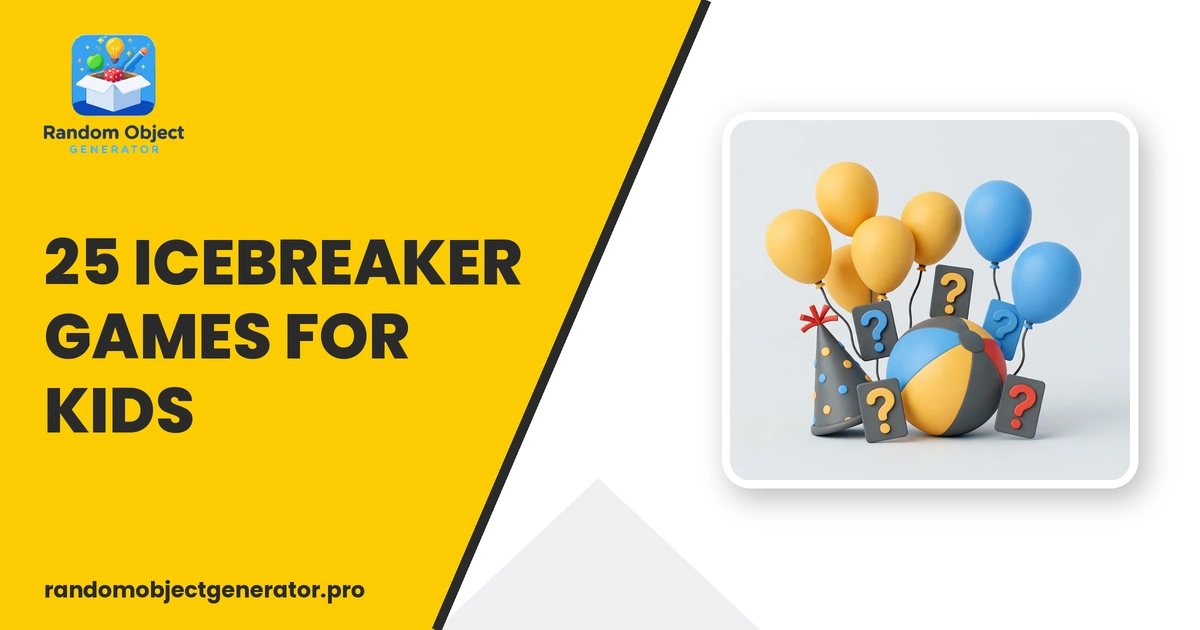
Put a question slip inside each balloon before inflating. Kids pop a balloon, read the question, and answer it. “What superpower would you pick?” beats “tell us about yourself” every time. Ten minutes, loud, and every pop is a little celebration.
20. Telephone Pictionary
Each child writes a silly sentence, passes it on, and the next child draws it. The drawing passes on, the next child writes what they think it shows, and so it goes. The final reveal, where the sentence turned into something unrecognizable, gets the biggest laughs of the party.
21. Memory Tray
Show a tray of ten small objects for thirty seconds, cover it, and have kids write down what they remember. The winner names the most. Then let kids take turns adding one mystery object each. It is quiet, focused, and a nice breather between wild games.
22. M&M Color Stories
Each child takes a small handful of candies without eating them. Every color means a question: red is favorite movie, green is a fear, yellow is a dream. Kids answer one question per candy, then eat them. Sweet, simple, and over in ten minutes.
23. Simon Says New Kid Edition
Play Simon Says but every command reveals something: “Simon says touch someone wearing blue,” “Simon says stand next to someone with the same favorite season.” Kids learn about each other while playing a game they already know. Five minutes, no setup.
24. Compliment Circle
Sit in a circle and pass a ball. Whoever holds it gives a genuine compliment to the person on their left, then passes. “I like your dinosaur shirt” counts. It takes five minutes and ends with every child having heard something nice about themselves. Save it for the end of the party.
25. Freeze Frame Story
One child strikes a pose and freezes. The next child joins the pose and adds one sentence to a story. Keep adding kids and sentences until everyone is in the scene. It is part theater, part storytelling, and the final frozen group photo is a great party souvenir.
How Do You Pick the Right Icebreaker for Your Group?
Match the game to three things: age, group size, and energy level. Younger kids need movement and simple rules; older kids need a challenge or a funny twist to buy in. Groups over fifteen need circle or team formats so nobody waits long for a turn.
Read the room in the first two minutes. A nervous, quiet group needs a no-speaking-first game like Memory Tray or Category Line-Up. A loud, bouncy group needs to move, so pick Human Knot or All Aboard before they bounce off the walls. When in doubt, start small: one five-minute game beats one failed fifteen-minute game.
Keep a backup game ready. If the first pick flops, switch fast instead of pushing through. Kids forgive a quick change; they do not forgive ten minutes of confusion. For classroom mornings specifically, our 10 classroom warm-up games pair well with these icebreakers as a daily routine.
The quotable truth: Kids remember the game where they laughed, not the one where they waited for instructions.
What age group are icebreaker games for kids best for?
Most icebreaker games for kids work best for ages 5 to 12, with simple tweaks for each end. Kids under 7 do better with movement games like Freeze Dance or Name Ball Toss, while ages 9 to 12 enjoy guessing and strategy games like Who Am I or Telephone Pictionary. Teens usually prefer the party-style games with a competitive twist.
How long should an icebreaker game for kids last?
Five to fifteen minutes is the sweet spot for an icebreaker game with kids. Under five minutes feels rushed and kids barely warm up. Past fifteen minutes, the game stops being an icebreaker and becomes the main activity, which is fine if that is the plan. For classrooms, aim for the shorter end so the lesson still gets its time.
Do icebreaker games for kids need any equipment?
Almost none. Most of the games on this list need only a ball, paper, or nothing at all. Name Ball Toss needs one soft ball. Find Someone Who and Snowball Introductions need paper and a pen. If you have zero supplies, pick Would You Rather Stand-Up, Category Line-Up, or Simon Says, which run on voices and space alone.
What is the easiest icebreaker game for shy kids?
Games where nobody has to speak first work best for shy kids. Memory Tray, Category Line-Up, and Snowball Introductions let a quiet child participate fully before saying a word. Partner Walk and Talk also helps because walking side by side feels safer than facing a group. Avoid putting a shy child in the spotlight in the first round.
How do you play icebreaker games with a very large group of kids?
Split the group into circles or teams of eight to twelve and run the same game in parallel. Human Bingo, Find Someone Who, and Partner Walk and Talk all scale well this way. For movement games like Human Knot, smaller circles of ten untangle faster and keep everyone involved. One adult per circle keeps parallel games on track.
Twenty-five games is more than any single class, camp day, or party needs. Pick two or three that fit your group, keep a backup in your pocket, and let the kids do the rest. The point was never the perfect game. It was the moment a quiet kid laughed with a stranger and stopped being a stranger.
If your icebreakers work best with pictures and prompts, try the free random object generator for instant game material, or browse the pictionary words list when a drawing round breaks out.
For vocabulary practice after introductions, try our 15 ESL vocabulary games with pictures.