
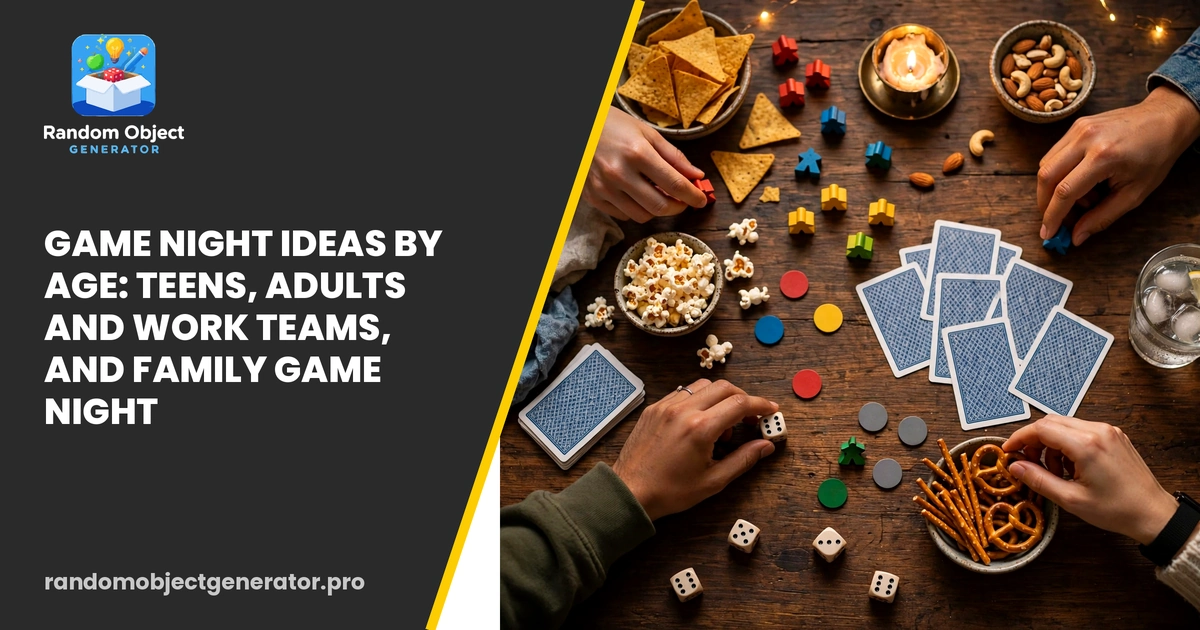
Game Night Ideas by Age: Teens, Adults and Work Teams, and Family Game Night
Most game nights fail for one simple reason: the games fit one age group and bore or embarrass everyone else. This page fixes that. Pick your group below, run one game from its list, and keep the whole night under 90 minutes. Every game here needs nothing you do not already own, works without a board or an app, and pairs with our free random object generator when you need a fresh prompt mid-game.
A good game night fits the people in the room, not the box on the shelf.
Teens do not hate game night. They hate being forced to perform in front of everyone.
The best family game is the one where the youngest player and the oldest player both have a real chance to win.
What game night games work for teens?
Teens play when the game gives them status, speed, and a way to be funny without standing alone in front of the room. Skip games that force one teen to perform while everyone watches in silence. Use team formats, short rounds, and topics teens already argue about.
Hot Take Tournament. Split into teams of three or four. Give each team a silly topic, such as school lunch, homework, or the best season. One player gets 30 seconds to defend a hot take, and the other team gets 30 seconds to reply. The group votes for the funnier argument, not the truer one. Run it as a bracket until one team remains. Rounds stay short, nobody performs alone, and quiet teens can write the argument while a louder teammate delivers it.
Product Pitch Challenge. Show the group one random object from the free random object generator, or pull one item from a bag. Teams get three minutes to invent a product pitch for it: a name, one slogan, and one reason anyone would buy it. Each team pitches in 60 seconds. Score one point for the funniest pitch and one point for the most convincing pitch. This works for teens because it rewards quick thinking and humor, and the random object keeps every round different.
Caption Showdown. Show a funny photo, a random object picture, or a drawing from the night, and give everyone two minutes to write one caption for it. Read the captions out loud without names attached, and let the group vote for the best one. Anonymous voting is the key. Teens who would never joke out loud will write a sharp caption when their name is not on it.
Teen night plan: 4 to 12 players, 60 to 90 minutes, three games maximum. Let teens pick the music and the snacks, and let them pass on any round without a penalty. One forced round loses the whole night.
What game night games work for adults and work teams?
Adults and work teams need games that respect time, avoid embarrassment, and still get people talking about something other than work. Skip games that single people out, ask for personal secrets, or run past 30 minutes. The best work team games let everyone contribute from their seat.
Desk Drawer Detective. Each player puts three small everyday items on the table, or lists three items from their desk, bag, or kitchen drawer. The group guesses which items belong to which person. Score one point per correct match. This game works for coworkers because it is personal without being private, and it starts real conversations about hobbies and habits.
Sixty Second Startup. Give each team one random object from the free random object generator. Teams get three minutes to plan, then 60 seconds to pitch that object as a new product to the room. The group votes for the best pitch. Keep it to work teams of four to six, cap the whole game at 20 minutes, and ban real work topics so the game stays a break from work instead of another meeting.
Skill Swap Round. Each player teaches the group one small skill in two minutes: a shortcut, a recipe step, a knot, a drawing trick, or a phrase in another language. No slides, no prep, just show and tell. This is the strongest work team game in this list because everyone leaves knowing something new, and quiet experts get a turn without a spotlight round.
Adults and work teams night plan: 6 to 20 players, 30 to 60 minutes, two games maximum for a lunch break or after work session. Play in teams, keep score on paper, and end on time even if the game is going well. Ending on time is what gets adults to come back next time.
What games work for a family game night with mixed ages?
Family game night has the hardest job of all: a 7 year old, a teenager, a parent, and a grandparent at the same table. The games below work because they give every age a different way to win. Younger kids win on speed and luck, teens win on humor, and adults win on memory and stories.
Grandparent Interview Round. Kids prepare five questions before the night, such as what games you played at my age, what your first job was, or what food you hated as a kid. One adult or grandparent answers while the kids listen for a detail to repeat back. Score one point for every answer a child can retell in their own words. This game turns family history into play, and it is the round grandparents remember most.
Pantry Tower Build. Teams get five minutes and only items from the kitchen pantry, such as cans, boxes, and plastic containers. The tallest freestanding tower wins, and the funniest collapse gets a bonus point. No tools, no buying, and younger kids can build while older players plan. Photograph each tower before it falls, and let the group vote for the best design.
Generation Trivia Relay. Each generation writes five questions for the others: kids write questions about school and games, teens write questions about music and shows, and adults write questions about family memories and everyday life. Teams answer in relay order, one question at a time, with 30 seconds per answer. Writing the questions is half the fun, because each generation tries to stump the others with topics they know best.
Family night plan: 4 to 12 players, 60 to 90 minutes, three games maximum. Pair younger kids with an adult teammate, let anyone pass on a round, and keep a small prize for the winning team, such as picking the next movie or the next snack. End with one calm round, such as the interview round, so younger kids wind down before bed.
How do you plan a game night for any age in 10 minutes?
Use this quick planning table before guests arrive:
| Group | Best opener | Group size | Time per game |
|---|---|---|---|
| Teens | Hot Take Tournament | 4 to 12 | 30 seconds per argument |
| Adults and work teams | Desk Drawer Detective | 6 to 20 | 20 minutes |
| Family mixed ages | Pantry Tower Build | 4 to 12 | 5 minutes to build |
Three planning rules cover every age group. First, pick two or three games, not six, and start the first one within ten minutes of everyone arriving. Second, match the game to the room: seated games for work teams and dinner nights, movement games for teens and family nights with space. Third, keep a backup ready: open the free random object generator and you have fresh prompts for pitch games, caption games, and drawing rounds the moment a game runs dry. The tool is free, needs no sign-up, and works on a phone.
What game night games work for teens who say they are too old for game night?
Team games with short rounds work best, because no teen has to perform alone in front of the room. Try Hot Take Tournament, Product Pitch Challenge, or Caption Showdown, and let teens write arguments or captions instead of speaking first. Keep the night under 90 minutes, let players pass on any round, and let teens pick the music and snacks.
What games work for a work team in 30 minutes or less?
Desk Drawer Detective and Sixty Second Startup both fit a 30 minute lunch break, because they run in teams and need no setup. Keep groups to four to six players, score on paper, and end on time if the game is going well. Avoid games that ask for personal secrets or single people out, since those make coworkers uncomfortable.
How do you run a family game night with ages 7 to 70 at one table?
Pair younger kids with an adult teammate, and pick games where every age can win: speed and luck for kids, humor for teens, and memory and stories for adults. Pantry Tower Build and Generation Trivia Relay work for mixed ages. Keep each game under 20 minutes, cap the night at three games, and end with a calm round.
How many games should you plan for one game night?
Plan two games for a work team session and three games for a teen or family night, and no more. Short nights beat long nights, because energy drops after 90 minutes and players start checking their phones. If one game runs well, let it run longer instead of rushing to the next game on your list.
What should you do when a teen refuses to play a game?
Let them pass on that round without a penalty, and offer a behind the scenes role such as scorekeeper, timer keeper, or judge. Many teens join the next round once they see the game is safe and funny. Never force a teen to perform alone, tease them for passing, or make game night a punishment for skipping.