What Is a Random Object Generator? How It Works and Ways to Use It
A random object generator is an online tool that gives you an everyday object picked at random, with one click. You set a quantity and, often, a category. The tool then pulls items from its database and shows them to you as a list, so you have an instant starting point for a creative or learning task.
You don’t need to sign up or install anything. You press a button, and you get an object such as a kettle, a compass, or a pillow. That’s the whole idea: take the choice out of your hands so your brain can focus on what to do with the result.
How Does a Random Object Generator Work?
A random object generator works in three steps. You set your options, the tool picks items from a stored list, and it displays your results.
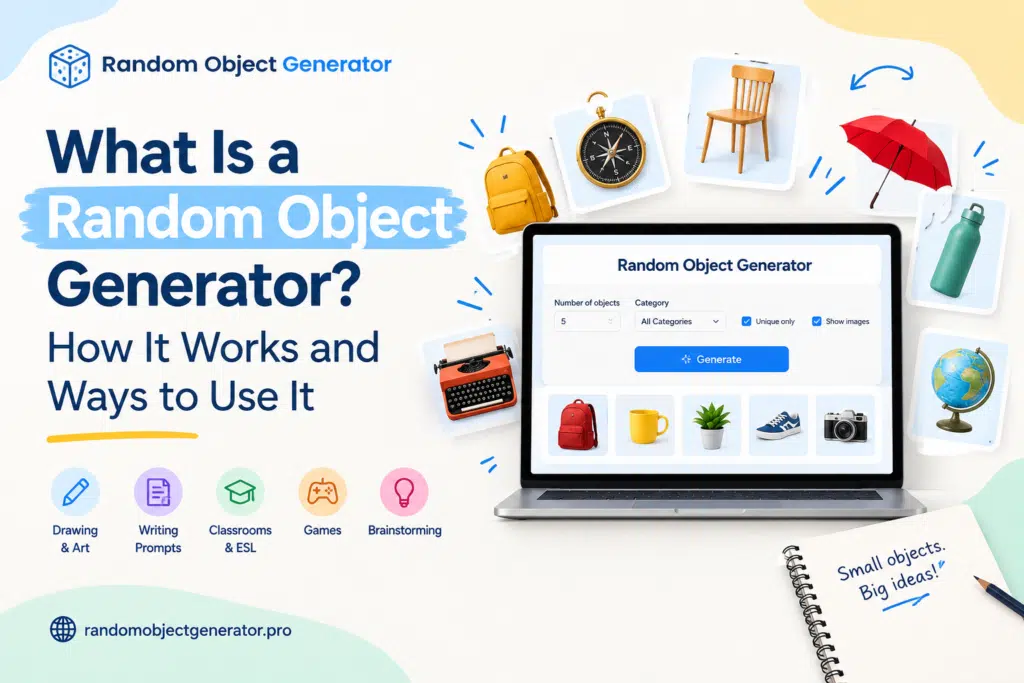
- You set the options. This usually means a quantity (how many objects you want) and, on tools that support it, a category such as household, nature, or office.
- The tool selects items. It pulls from a database of objects that match your category. A setting often called “unique only” controls whether the same object can appear twice in one list.
- You get your results. The objects appear as a list, sometimes with pictures. You can copy the list or save the images for later use.
This is different from a random number generator, which only outputs digits. A random object generator outputs nouns, specifically things you can picture or draw, which makes it useful for creative and visual tasks in a way a number never could be.
Is a random object generator actually random?
Within its database, yes. The tool can’t choose something that isn’t on its list, but which item it picks from that list is not predictable. That’s enough randomness for creative use. You’re not trying to break a lock, you’re trying to break a habit of always reaching for the same idea.
What Can You Generate With It?
Most tools let you control three things: how many objects you get, which category they come from, and whether you see a picture with each one.
- Quantity. Generate 1 object for a single prompt, or up to 100 for a full worksheet or long brainstorm.
- Category. Narrow results to a theme, such as household items, nature, office supplies, or more abstract and fantasy objects.
- Images. Turn on a picture mode to see what each object looks like, which helps visual thinkers and language learners. Try our random object generator with pictures for a version built around this.
A single random object generator covers names like random item generator, random thing generator, and object randomizer. These are different names for the same kind of tool, and most of them work the same way.
Why Use a Random Object Generator?
A random object generator saves you from the hardest part of starting a creative task: deciding where to begin. Facing a blank page or an empty sketchbook causes decision fatigue, which is the mental tiredness that builds up after making too many small choices in a row.
It forces new connections. When your brain sees two unrelated objects, it works to link them. That effort is where new ideas come from. A lantern and a bicycle wheel don’t naturally belong together, so finding a link between them stretches your thinking further than a familiar prompt would.
It removes personal bias. A random pick isn’t influenced by what you already like or already know. That makes it useful anytime you want a fair, unplanned starting point, from a drawing subject to a game challenge.
It works for any skill level. A beginner artist and a professional illustrator can both use the same random object as a warm-up. The prompt is simple; what you do with it is up to you.
Ways to Use a Random Object Generator
For drawing and art
Generate one to three objects and sketch each one for a few minutes. Daily practice with random objects builds observation skills, because you’re drawing what’s actually suggested instead of what you always draw. Many artists use a timed round, such as five minutes per object, to keep the exercise focused.
For writing prompts
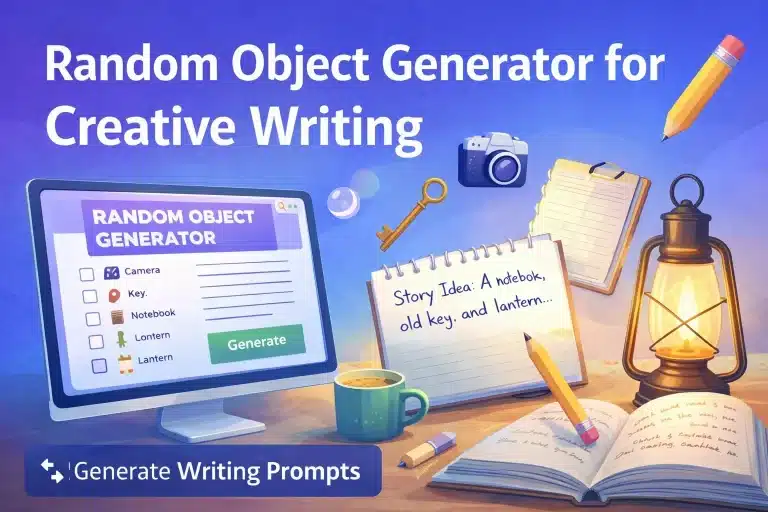
Writers use a random object as a plot device or a scene detail. A single object, such as a torn letter or a brass key, can become the center of a short story. Combine two objects to build a stronger prompt. For example, a key and a map together suggest a search or a journey.
For classrooms and ESL
Teachers generate a short list and ask students to name, describe, or spell each object. Picture mode helps younger students and English learners connect a new word to its meaning without needing a translation. It also works well for quick icebreakers at the start of a lesson.
For games
Random objects work for Pictionary, charades, and scavenger hunts. Generate a list, then have players act out, draw, or find each item. A larger batch, such as 20 objects, is enough for a full round with no repeats if you turn on unique mode.
For brainstorming
Teams use two unrelated objects to force a new angle during a planning session. Combine a household item with a piece of technology, then ask what a product that merges both might look like. The exercise works because it blocks the usual, familiar ideas from coming up first.
Random Object Generator vs. Similar Tools
If you specifically want something you can picture, hold, or draw, a random object generator is the right tool. The others are built for different kinds of randomness. For a closer look at what makes one generator better than another, see our guide to the best random object generator.
| Tool | What it gives you |
|---|---|
| Random object generator | A physical, everyday item (a cup, a ladder, a stapler) |
| Random word generator | Any word, not limited to physical objects |
| Random noun generator | Any noun, which can include people and places, not just things |
| Random number generator | A number, with no creative or visual element |
If you specifically want something you can picture, hold, or draw, a random object generator is the right tool. The others are built for different kinds of randomness.
Frequently Asked Questions
What is a random object generator used for?
A random object generator is used for drawing prompts, creative writing, classroom activities, games, and brainstorming. It gives you a random, everyday item as a starting point, so you don’t have to spend time deciding what to work with. People also use it as a quick warm-up exercise before a longer creative session.
How does a random object generator pick its results?
It selects items from a stored database that matches your chosen category. If unique mode is on, it won’t repeat an object within the same list. Press generate again for a new, different result. The exact item is unpredictable, even though it always comes from the same underlying list.
Is a random object generator free to use?
Most random object generators, including ours, are free with no sign-up required. You can generate as many lists as you want, in any quantity the tool allows, with no hidden limits. Some tools also let you download images of each object at no extra cost.
Can I use a random object generator on my phone?
Yes. Random object generators run in your browser, so they work on phones, tablets, and computers without an app. Set your options, tap generate, and your list appears right away. You can copy the list or save any images directly to your device.
What’s the difference between a random object generator and a random word generator?
A random object generator only gives you physical, visual things, like a chair or a spoon. A random word generator can give you any word, including abstract ones like “freedom” or “patience.” Use an object generator when you need something you can draw or picture, and a word generator for broader language prompts.