Beginner Drawing Prompts by Skill Level and Mood: Easy Things to Draw Today
Pick your skill step first, then your mood. A beginner who starts with a hard subject quits early, and a tired person who picks a high-energy prompt never starts at all. This page fixes both problems: prompts that match what you can already do, and prompts that match how you feel right now.
What makes a drawing prompt good for a beginner?
A good beginner prompt has one clear shape, few details, and no pressure to look real. If you can describe the prompt in one short sentence, you can draw it. If the prompt needs a paragraph of explanation, save it for later. Start simple, finish the sketch, and let the small win carry you to the next one.
Which beginner prompts build line control first?
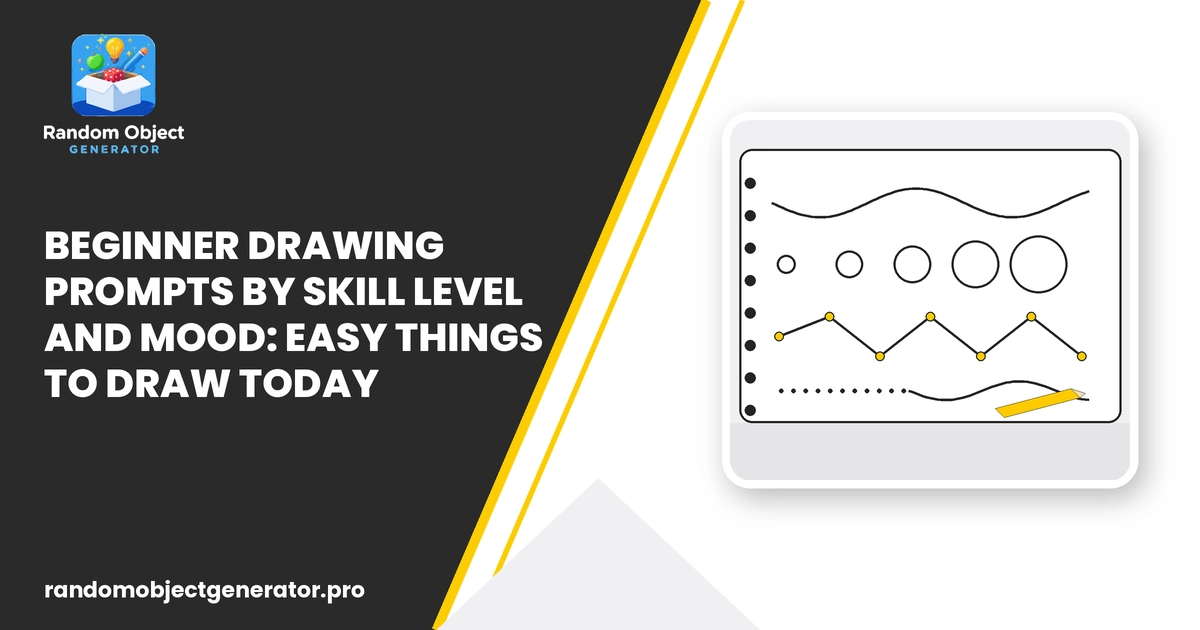
Line control comes before shading, before detail, and before realism. These five prompts train your hand to go where you tell it to go. Draw each one slowly, with no erasing, and repeat any that feel shaky.
- A wavy ribbon running across the whole page, drawn in one line without lifting your pencil
- A row of five circles in a row, each one a different size, with no ruler
- A zigzag path with one dot at every turn
- A single line that loops back on itself five times and never crosses itself
- A dotted line that slowly turns into a smooth wave
Which beginner prompts teach shape building?
Once your lines behave, build subjects from two or three basic shapes. Every prompt below uses only circles, triangles, rectangles, or ovals, so you always know where to start.
- A diamond kite with a wavy tail, built from two triangles
- A pyramid made from three stacked triangles
- A rocket built from one tall rectangle and one triangle on top
- A fish built from one oval body and one triangle tail
- A round ball with light on the left side and shadow on the right side
Which beginner prompts make a simple scene?
A scene is just two or three easy subjects placed together. These prompts give you a finished picture in ten minutes, with no single hard part.
- A small boat on calm water, with one soft reflection under it
- A round-topped tree standing on a small hill
- A bridge crossing a narrow stream, with two bushes on one bank
- A window at night with stars outside and one lamp glowing inside
What should I draw when I want to relax?
Calm prompts use slow lines, soft shapes, and quiet scenes. There is nothing to rush here. Draw at half your normal speed and let the sketch stay simple.
- A quiet lake at sunrise, with mist sitting low on the water
- A cat asleep on a windowsill in a patch of sunlight
- Steam curling up from a warm drink on a cold morning
- A path winding through a quiet garden, with no people on it
- The moon reflected in still water, drawn as one soft oval
What should I draw when I feel happy and bright?
Bright prompts use open space, upward movement, and color-friendly subjects. If you have colored pencils, this is the list to use them on.
- Balloons floating up over a row of rooftops
- A dog with a wagging tail, mid-bounce in a yard
- Confetti falling over an empty dance floor
- A field of sunflowers under a clear blue sky
- A child jumping in puddles after summer rain
What should I draw when I feel low on energy?
Low-energy prompts are kind on purpose. They use slow subjects, gentle shapes, and no deadlines. You are allowed to stop after one sketch and call it done.
- An empty swing swaying in light rain
- A lone lighthouse standing in thick fog
- A sealed letter that was never sent, resting on a desk
- A wilting flower in a plain glass of water
- Footprints crossing fresh snow toward a distant door
What should I draw when I feel restless or full of energy?
Restless prompts give fast lines somewhere to go. Use big paper, a thick pencil, and a timer. Speed is the point here, not neatness.
- A surfer riding a big wave, leaning hard into the turn
- Waves crashing over dark rocks at the edge of a cliff
- A kite pulling hard against a strong wind
- A runner mid-stride on an empty track
- Sparks rising from a campfire into a night sky
What should I draw when I feel nostalgic?
Nostalgic prompts work from memory, not from a photo. Draw what you remember, not what was really there. The gaps in your memory are part of the picture.
- Your childhood street, drawn the way you remember it
- A grandparent’s kitchen table set for an ordinary meal
- An old photo frame holding a blank photo
- A toy you owned as a child, drawn larger than life
- A school bus on its morning route, with fog on the windows
How do I turn one prompt into a week of practice?
Pick one prompt and draw it seven days in a row, changing one thing each day. This turns a single idea into real skill, because you stop starting over and start improving.
| Day | What changes |
|---|---|
| 1 | Draw the prompt as it is, in five minutes |
| 2 | Draw it twice as large |
| 3 | Draw it from a different angle |
| 4 | Draw it with your non-dominant hand, just for looseness |
| 5 | Add one background element, like sky, ground, or a wall |
| 6 | Draw it in ink, with no pencil sketch underneath |
| 7 | Redraw your day 1 version and compare the two side by side |
If choosing still feels hard, let the free random object generator on our homepage pick a subject for you, then match it to the skill step and mood list above. For structured object practice, see our everyday objects to draw list. For body positions to pair with a prompt, see our 50 random poses to draw. For a daily hand warm-up first, see our 10-minute drawing warm-ups for beginners. For pure fun ideas with no skill order, see our 100 things to draw when bored.
What is a beginner drawing prompt?
A beginner drawing prompt is a simple drawing idea built around one clear shape and few details. It removes the hardest part of starting, which is deciding what to draw. Good prompts use subjects you can describe in one sentence, so you spend your time drawing instead of planning, and you finish with a sketch you can feel good about.
How do I choose a prompt that fits my mood?
Match the energy of the prompt to the energy you have right now. Calm moods suit slow, quiet scenes like lakes and sleeping animals. High-energy moods suit fast subjects like waves and runners. Low-energy days call for gentle, simple subjects with no deadline. When the prompt matches your mood, starting feels easy instead of forced.
How long should I spend on one beginner prompt?
Five to ten minutes is enough for most beginner prompts on this page. A short timer keeps you focused on big shapes instead of tiny details, and it stops one sketch from eating your whole evening. If a prompt still feels fun when the timer rings, keep going. If it feels like work, stop and pick a fresh one tomorrow.
What should I do when my drawing looks nothing like the prompt?
Keep it and draw the prompt again tomorrow. A first sketch that misses the mark still trains your hand and your eye, and the second version is almost always closer. Compare the two versions to spot what changed, like a shape that got wider or a line that got steadier. Progress in drawing looks like small corrections, not sudden perfection.
Can I use mood-based prompts with kids or students?
Yes, mood-based prompts work well in classrooms and at home because they give kids words for feelings and a way to draw them. A teacher can ask the class to pick a mood, then a prompt from that list, so everyone starts together. Keep sessions short, skip grading the art, and let students share their sketches if they want to.