10-Minute Drawing Warm-Ups for Beginners
A drawing warm-up is a short sketching drill that loosens your hand before you start drawing for real. Ten one-minute exercises are enough: quick lines, circles, gesture sketches, and one blind contour. This post gives you the full ten-minute routine that beginners can follow every day.
Why Do Drawing Warm-Ups Matter?
Your first ten minutes of drawing are usually your worst. Your lines are stiff, your circles wobble, and everything you draw looks slightly wrong. This is not a talent problem. It is a cold-hands problem. Musicians tune their instruments and athletes jog before a match. Drawers sketch warm-ups.
A warm-up moves the stiffness from your finished drawing into throwaway practice. After ten minutes of drills, your lines flow and your real drawing starts at your actual skill level instead of below it.
The quotable truth: Ten minutes of ugly sketches teaches your hand more than ten minutes of thinking about drawing.
How Long Should a Drawing Warm-Up Be?
Ten minutes is enough for beginners. Set a timer and give each of the ten exercises below exactly sixty seconds. The timer matters because it stops you from polishing. A warm-up you spend forty minutes perfecting is not a warm-up. It is procrastination with a pencil.
If ten minutes feels long, do five exercises for five minutes and build up over a week. A short warm-up beats no warm-up every time.
What Do You Need for a Drawing Warm-Up?
You need almost nothing. One pencil or pen, cheap paper or a spare notebook, and a phone timer. Use a pen if you want to force commitment, since you cannot erase. Use a pencil if the blank page scares you and you want a gentler start.
Keep a dedicated warm-up notebook or a stack of scrap paper, separate from your finished drawings. And here is the house rule: the eraser is banned during warm-ups. This page is not for your portfolio.
10 Drawing Warm-Up Exercises for Beginners
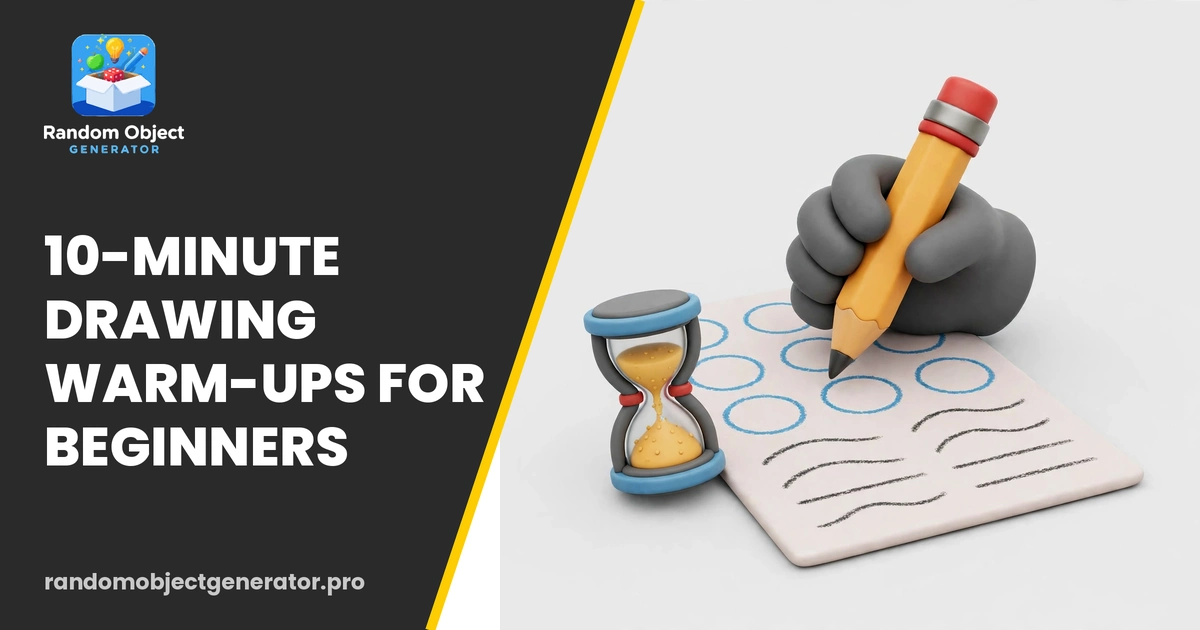
Do each exercise for sixty seconds, in order. Move to the next one when the timer rings, even if the page looks unfinished. Unfinished is the point.
1. Loose Scribble Circles
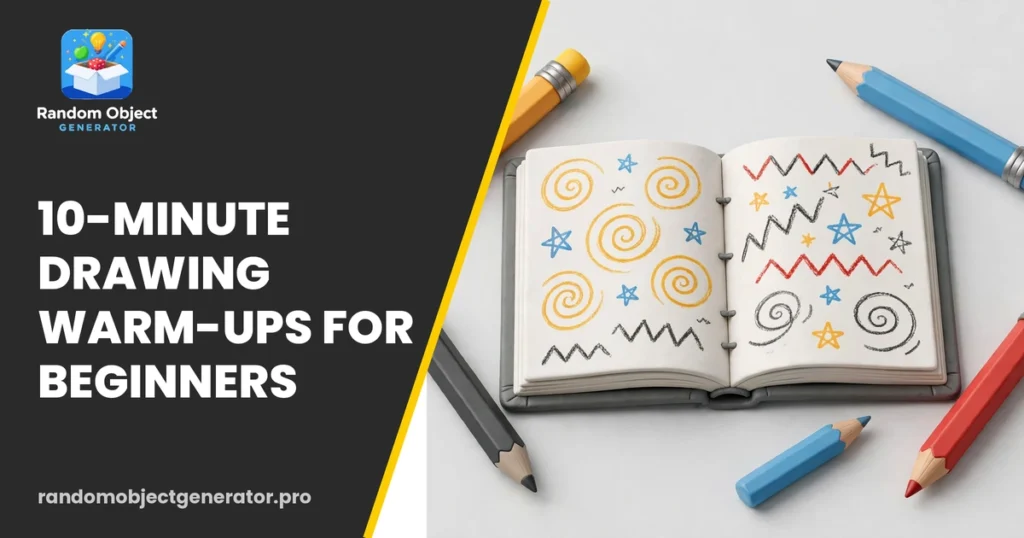
Fill a page with big, loose circles as fast as you can. Draw from your shoulder, not your wrist, and let the circles overlap. They will look like a mess. That is the goal. This exercise loosens the shoulder muscles that draw smooth curves and breaks the habit of tiny, tight wrist drawing. Make it harder: draw the circles with your non-dominant hand.
2. Straight Line Drills
Draw a page of parallel straight lines, first slowly and then faster. Aim for even spacing and consistent length, but do not slow down to fix wobbles. This trains the hand control you need for confident outlines.
3. Ellipse Rows
Draw rows of tilted ellipses, like a page of eggs leaning the same way. Keep them the same size and the same tilt. Ellipses show up everywhere: cups, faces, wheels, bottle tops. A steady ellipse is worth more than it looks.
4. Continuous Line Drawing
Pick an object near you and draw it without lifting your pen from the paper. Follow every edge with one unbroken line. Your drawing will have weird gaps and overlapping paths. That is fine. This exercise forces your eyes to stay on the object instead of sneaking peeks at the paper, which builds observation speed. Make it harder: draw a second object with the same unbroken line.
5. Blind Contour
Look only at the object, never at your paper, and draw its outline slowly. Do not peek. Your result will look wonderfully wrong, like the object melted. This exercise rewires your attention: you stop drawing what you think an object looks like and start drawing what you actually see.
6. One-Minute Gesture Sketch
Grab a spoon, a shoe, or anything with an interesting shape and sketch its overall gesture in one minute. Big shapes first, details last. Gesture drawing trains you to capture the whole thing fast instead of getting stuck on one corner. If the timer rings mid-line, put the pen down. The half-finished sketch still taught you something. Make it harder: do three objects in three one-minute rounds.
7. Hatching Ladder
Draw five small boxes in a row. Fill the first box with very light hatching and make each box darker until the last is nearly solid. Keep your strokes going the same direction. This is value control in its simplest form, and it is the foundation of all shading. Uneven boxes are normal at first. They even out fast with daily practice. Make it harder: use cross-hatching, two stroke directions.
8. Negative Space Sketch
Instead of drawing an object, draw the empty space around it. If a mug sits on the table, draw the shapes of the table around the mug. This flips your brain out of symbol mode (drawing your idea of a mug) and into seeing mode (drawing actual shapes). Beginners often find this easier than drawing the object itself, which tells you how much of drawing is really about looking. Make it harder: shade the negative space solid.
9. Memory Sketch
Look at an object for ten seconds, then hide it and draw it from memory for fifty seconds. Compare your sketch with the object when the timer ends. Notice which parts your brain invented and which parts it remembered correctly. This builds visual memory, which is what lets you draw things that are not in front of you. Make it harder: shrink the looking time to five seconds.
10. Random Object Speed Sketch
Generate a random object and sketch it in sixty seconds, no pausing to think. The randomness is the point: you cannot pick something easy, so your brain learns to solve drawing problems fast. A fire hydrant, a telescope, a pineapple. Whatever appears, you draw it. Speed kills overthinking, and overthinking is the beginner’s biggest enemy. Make it harder: generate three objects and combine them into one scene.
Need a Random Object for Exercise 10?
One click gives you a fresh, unbiased sketch subject. No repeats, no planning, no picking something easy.
5 Mistakes Beginners Make With Drawing Warm-Ups
Warm-ups only work if you treat them like warm-ups. Here is what usually goes wrong.
1. Skipping them on good days. You feel inspired and want to start the real drawing. Warm up anyway. Inspiration without a warm hand produces stiff lines and a page you abandon.
2. Erasing during warm-ups. Every eraser stroke teaches your hand that mistakes are emergencies. In warm-ups, mistakes are the curriculum. Leave them on the page.
3. Pressing too hard. A death grip on the pencil makes every line rigid. If your knuckles ache after ten minutes, you are pressing twice as hard as you need to. Lighten up and let the pencil do the work.
4. Ignoring the timer. The timer is what makes a drill a drill. Without it, exercises drift into fussy detail work and you lose the looseness you were building.
5. Judging the results. Warm-up pages are not art. They are the gym session before the game. If a warm-up page looks good, that is a bonus, not the goal.
How Do You Turn Warm-Ups Into a Daily Habit?
Attach the warm-up to something you already do. Sketch ten minutes with your morning coffee, or warm up before your evening drawing session. The routine sticks when it has a time slot and a trigger, not when it depends on motivation.
Keep the bar low on purpose. Five minutes counts. A tired Tuesday still counts. The artists who improve fastest are rarely the most talented. They are the ones who show up for ten ugly minutes a day. A warm-up you actually do beats a perfect routine you skip.
The quotable truth: A warm-up is not practice. It is the handshake between your hand and the page.
Warm Up With Real Photos, Not Just Words
Picture mode shows you a real photo of every random object, which makes gesture and contour exercises much more effective.
How long should beginners warm up before drawing?
Ten minutes is the sweet spot for beginners. That is enough for a full round of drills without eating into your drawing time. If you are short on time, even two to three minutes of line and circle drills will loosen your hand. Consistency matters more than length: ten minutes every day beats one long session a week.
Do drawing warm-ups actually improve your art?
They improve the start of every drawing session, which is where beginners lose the most ground. Warm-ups loosen your hand, sharpen your observation, and build line control through repetition. No drill is magic on its own. What makes them work is daily repetition: the same simple exercises, done often, train muscle control that shows up in your finished drawings.
What should I draw for warm-ups?
Draw anything, because the subject does not matter. Lines, circles, and ellipses cover the mechanical side. For the sketching exercises, use everyday objects: a mug, a shoe, a spoon, a plant. Random objects are better than chosen ones, because you cannot pick something easy and dodge the hard shapes you need to practice.
Can I do drawing warm-ups with a pen instead of a pencil?
Yes, and many artists prefer it. A pen forces commitment because you cannot erase, which teaches your hand to draw confidently on the first pass. Your warm-ups will look messier at first. That is the point. If a pen feels too harsh, start with a pencil for a week and switch when your lines feel steadier.
Where can I find random objects to sketch for practice?
A random object generator gives you a new sketch subject with one click, which is ideal for speed-sketch warm-ups. The picture mode is especially useful because it shows a real photo of each object, so you can practice gesture drawing and contour from an actual image instead of an imagined shape. It is free and needs no sign-up.
Once your hand is warm, put it to work. If you are looking for things to draw when you are bored, that post has a full list of ideas for every mood. And for daily practice, keep this list of 100 everyday objects to draw bookmarked. Pair either list with the random object generator with pictures for an endless supply of fresh sketch subjects.